Our History

What does 50 years of saving LGBTQ+ lives look like?

Thanks to our friends at Lambda Archives of San Diego, you can see for yourself.

In partnership with Lambda Archives, Stepping Stone has produced a traveling history exhibit tracing our story from a 1976 organizing meeting in South Park to the full-continuum recovery program serving the community today. The exhibit debuted at the Pink Gala and spans eight panels — each telling a different chapter.

1971–1979

Founding a safe place to tell the truth.

LGBTQ+ visibility grew after Stonewall, but safety remained fragile. The APA still classified homosexuality as a mental illness until 1973, when LGBTQ+ voices were finally heard and it was removed from the DSM. Against that backdrop, volunteers at the National Council on Alcoholism noticed a steady stream of calls from gay and lesbian people seeking help with drinking — twelve to fourteen calls a day.

On February 17, 1976, charter members convened the first organizing meeting at Metropolitan Community Church in Golden Hills to start a recovery home for gays and lesbians. By May, Stepping Stone had incorporated; by July, San Diego County Alcohol and Drug Services was funding the residential program. The first house stood across the street from what is now the San Diego LGBT Community Center.

In June 1979, the Central Avenue property was rented and Stepping Stone Central opened — five small houses, named and organized by function and resident community.
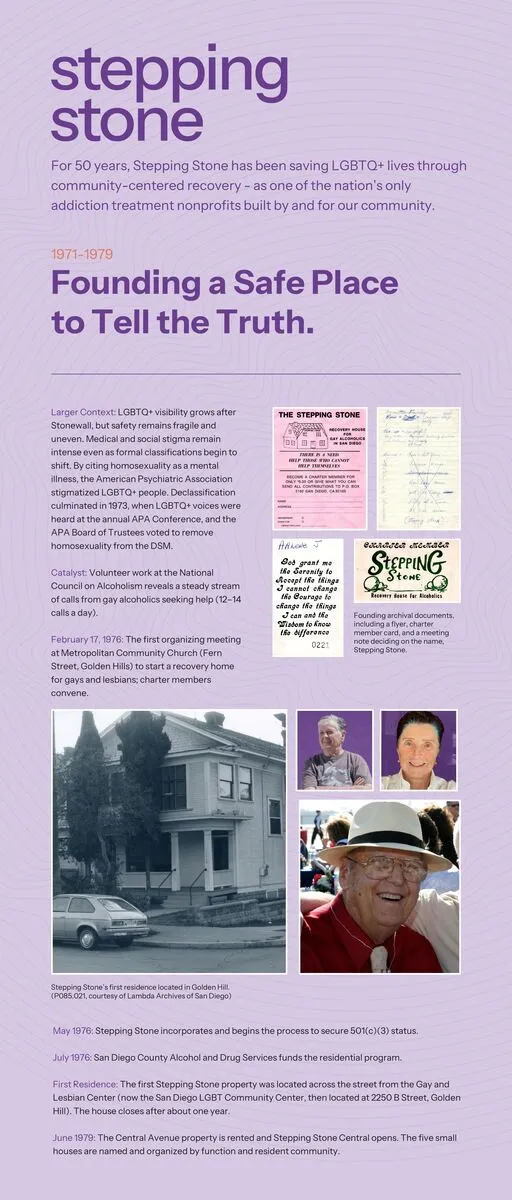
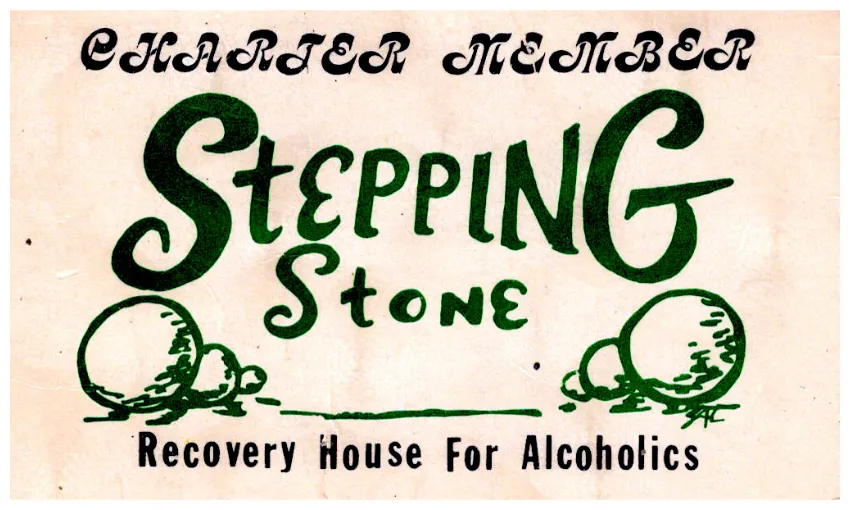
Exhibit panel one: Founding a Safe Place to Tell the Truth, 1971–1979, with founding archival documents and the first Golden Hill residence
Panel 01 · Lambda Archives x Stepping Stone 50th Anniversary Exhibit
Original charter member card in green ink reading Charter Member, Stepping Stone, Recovery House for Alcoholics
An original charter member card, c. 1976

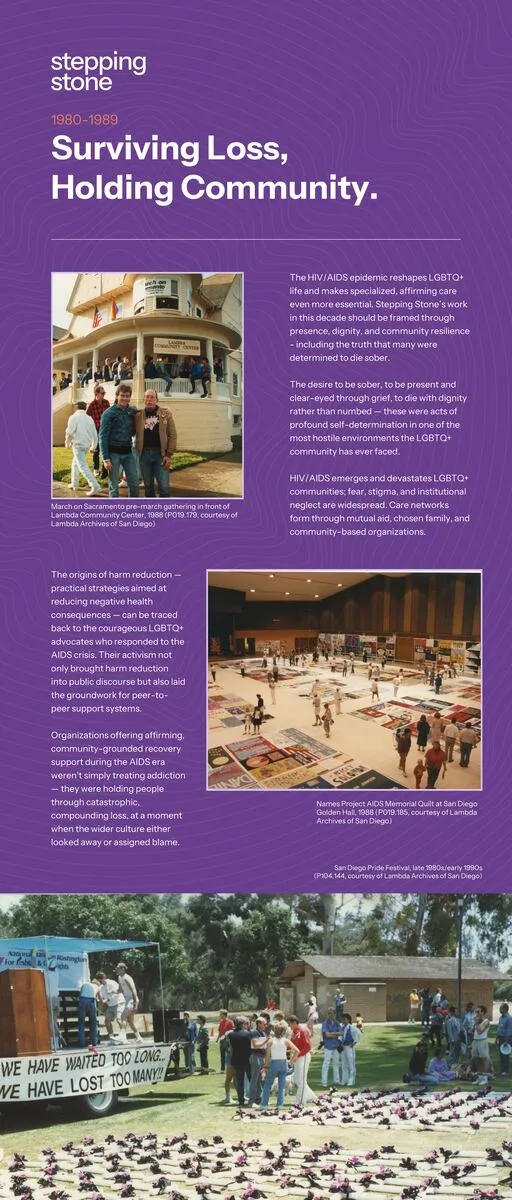
1980–1989

Surviving loss, holding community.

The HIV/AIDS epidemic reshaped LGBTQ+ life and made specialized, affirming care even more essential. Fear, stigma, and institutional neglect were widespread; care networks formed through mutual aid, chosen family, and community-based organizations.

Many who came to Stepping Stone in this decade were determined to die sober — to be present and clear-eyed through grief, to die with dignity rather than numbed. These were acts of profound self-determination in one of the most hostile environments the LGBTQ+ community has ever faced.

The origins of harm reduction trace back to the LGBTQ+ advocates who responded to the AIDS crisis. Organizations offering affirming recovery support in this era weren't simply treating addiction — they were holding people through catastrophic, compounding loss while the wider culture looked away or assigned blame.

Exhibit panel two: Surviving Loss, Holding Community, 1980–1989, with photos of the March on Sacramento and the AIDS Memorial Quilt in San Diego
Panel 02 · Lambda Archives x Stepping Stone 50th Anniversary Exhibit

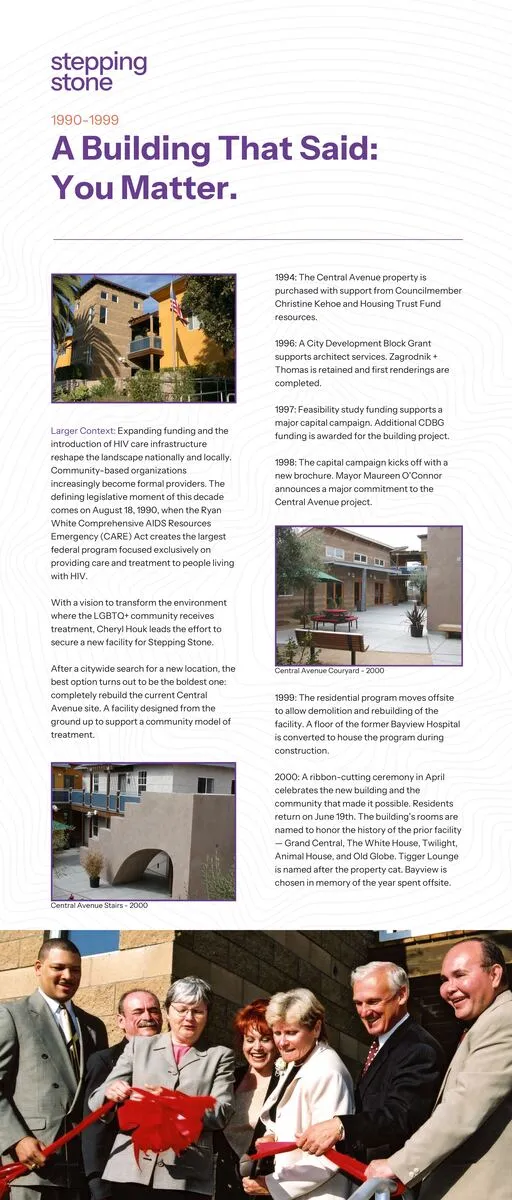
1990–1999

A building that said: you matter.

With a vision to transform the environment where the LGBTQ+ community receives treatment, Cheryl Houk led the effort to secure a new facility. After a citywide search, the best option turned out to be the boldest one: completely rebuild the Central Avenue site, designed from the ground up to support a community model of treatment.

In 1994 the Central Avenue property was purchased with support from Councilmember Christine Kehoe and Housing Trust Fund resources. Block grants funded the architects, a capital campaign kicked off in 1998, and in 1999 the residential program moved offsite — to a converted floor of the former Bayview Hospital — while the old houses came down.

An April 2000 ribbon-cutting celebrated the new building. The rooms were named to honor the prior facility — Grand Central, The White House, Twilight, Animal House, Old Globe — plus Tigger Lounge, after the property cat, and Bayview, in memory of the year spent offsite.

Exhibit panel three: A Building That Said You Matter, 1990–1999, with photos of the Central Avenue courtyard and stairs in 2000
Panel 03 · Lambda Archives x Stepping Stone 50th Anniversary Exhibit

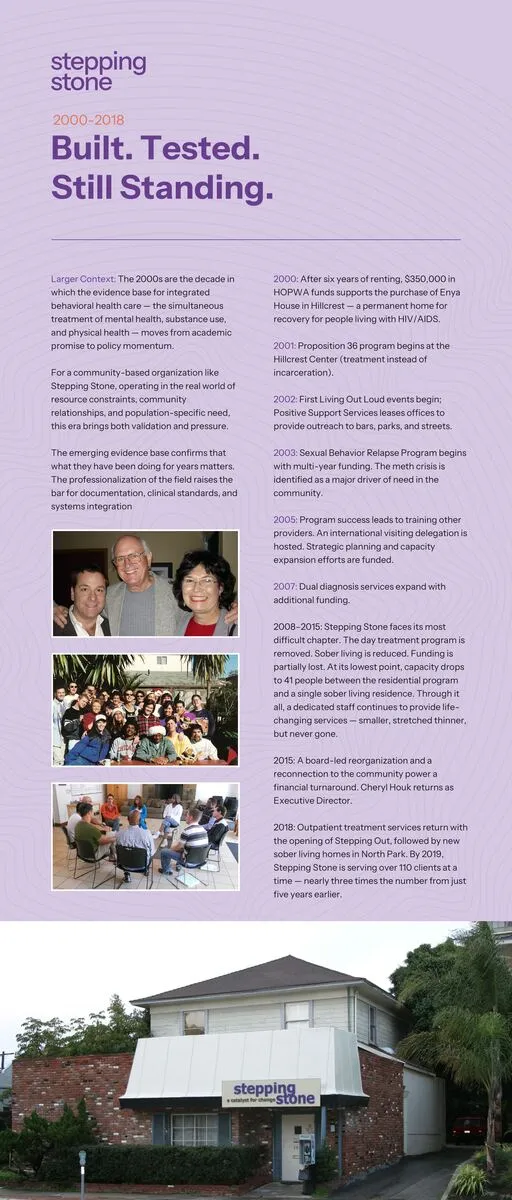
2000–2018

Built. Tested. Still standing.

The 2000s brought validation and pressure: the evidence base for integrated behavioral health care confirmed what Stepping Stone had been doing for years, while professionalization raised the bar for documentation and clinical standards. The decade opened with $350,000 in HOPWA funds purchasing Enya House in Hillcrest — a permanent home for recovery for people living with HIV/AIDS — followed by Proposition 36 programming, street outreach, and the Sexual Behavior Relapse Program as the meth crisis hit the community.

Then came the hardest chapter. Between 2008 and 2015, the day treatment program was cut, sober living was reduced, and funding was partially lost. At its lowest point, capacity dropped to 41 people. Through it all, a dedicated staff kept providing life-changing services — smaller, stretched thinner, but never gone.

A board-led reorganization and reconnection to the community powered a financial turnaround in 2015. By 2018, outpatient treatment returned with the opening of Stepping Out, followed by new sober living homes in North Park. By 2019, Stepping Stone was serving over 110 clients at a time — nearly three times the number from five years earlier.

Exhibit panel four: Built. Tested. Still Standing., 2000–2018
Panel 04 · Lambda Archives x Stepping Stone 50th Anniversary Exhibit

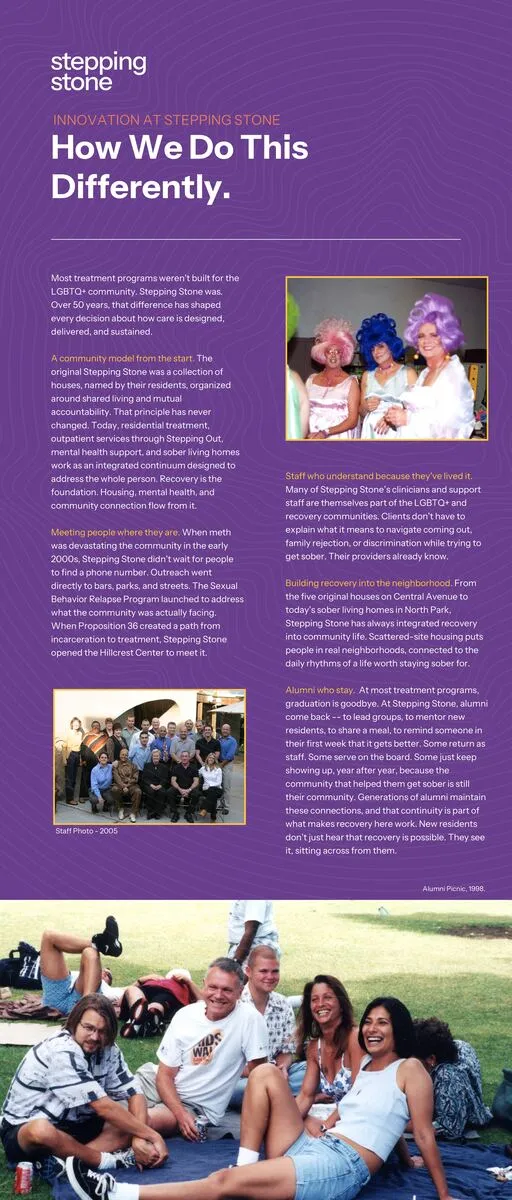
Innovation at Stepping Stone

How we do this differently.

Most treatment programs weren't built for the LGBTQ+ community. Stepping Stone was. The original organization was a collection of houses, named by their residents, organized around shared living and mutual accountability — and that principle has never changed. Today residential treatment, outpatient services, mental health support, and sober living work as one integrated continuum.

Many of Stepping Stone's clinicians and support staff are themselves part of the LGBTQ+ and recovery communities. Clients don't have to explain what it means to navigate coming out, family rejection, or discrimination while trying to get sober. Their providers already know.

And at most treatment programs, graduation is goodbye. At Stepping Stone, alumni come back — to lead groups, mentor new residents, serve on the board, or just keep showing up. New residents don't just hear that recovery is possible. They see it, sitting across from them.

Exhibit panel five: How We Do This Differently, on innovation at Stepping Stone
Panel 05 · Lambda Archives x Stepping Stone 50th Anniversary Exhibit

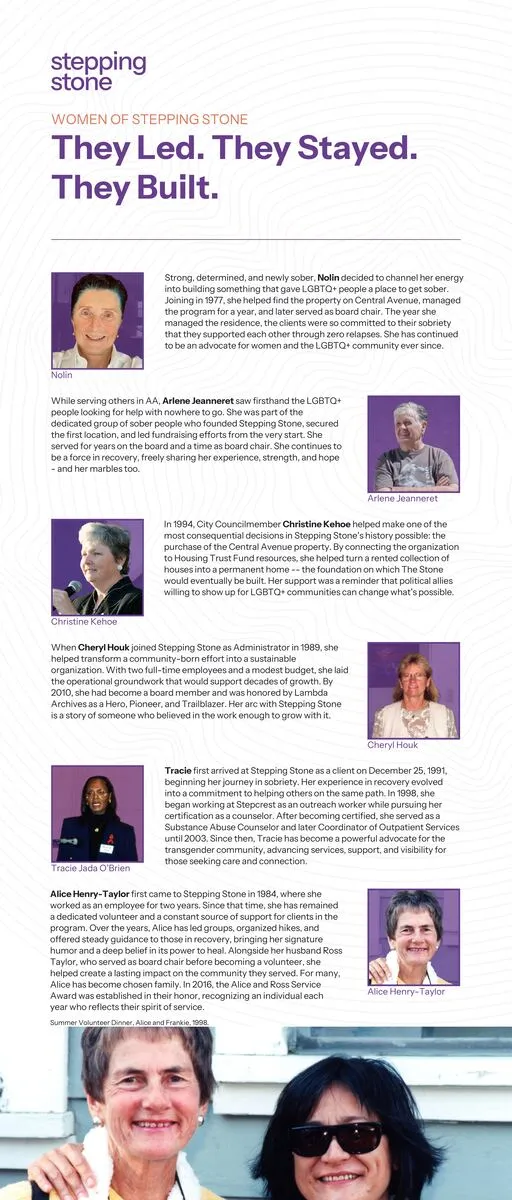
Women of Stepping Stone

They led. They stayed. They built.

Stepping Stone was built in no small part by women who refused to wait for permission. Nolin, newly sober, helped find the Central Avenue property in 1977, managed the program through a year of zero relapses, and later chaired the board. Arlene Jeanneret was among the founders who secured the first location and led fundraising from the very start.

City Councilmember Christine Kehoe connected the organization to the Housing Trust Fund resources that turned a rented collection of houses into a permanent home. Cheryl Houk, who joined as Administrator in 1989 with two full-time employees and a modest budget, laid the operational groundwork for decades of growth — and was honored by Lambda Archives as a Hero, Pioneer, and Trailblazer.

Tracie Jada O'Brien arrived as a client on December 25, 1991, became a counselor and Coordinator of Outpatient Services, and went on to become a powerful advocate for the transgender community. Alice Henry-Taylor first came in 1984 and has remained a volunteer and chosen family to generations of clients; the Alice and Ross Service Award is named for her and her husband.

Exhibit panel six: They Led. They Stayed. They Built. — portraits of the women of Stepping Stone
Panel 06 · Lambda Archives x Stepping Stone 50th Anniversary Exhibit

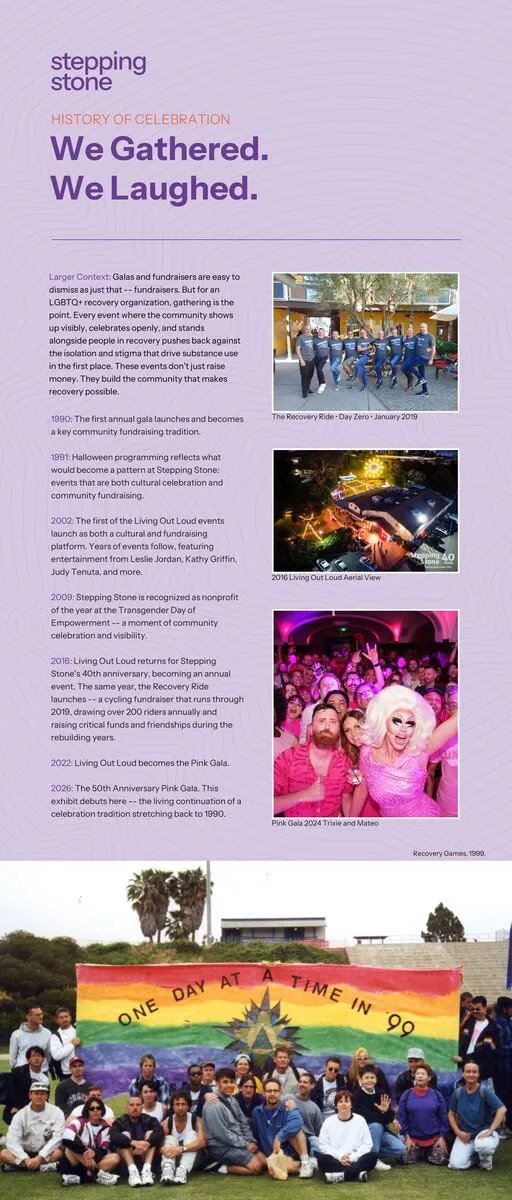
A History of Celebration

We gathered. We laughed.

For an LGBTQ+ recovery organization, gathering is the point. Every event where the community shows up visibly and celebrates openly pushes back against the isolation and stigma that drive substance use in the first place. These events don't just raise money — they build the community that makes recovery possible.

The first annual gala launched in 1990. Living Out Loud debuted in 2002, featuring entertainment from Leslie Jordan, Kathy Griffin, Judy Tenuta, and more, and returned for the 40th anniversary in 2016 — the same year the Recovery Ride began drawing over 200 cyclists annually through the rebuilding years.

In 2022, Living Out Loud became the Pink Gala. The 50th Anniversary Pink Gala in 2026 — where this exhibit debuted — is the living continuation of a celebration tradition stretching back to 1990.

Exhibit panel seven: We Gathered. We Laughed. — photos from the Recovery Ride, Living Out Loud, and the Pink Gala
Panel 07 · Lambda Archives x Stepping Stone 50th Anniversary Exhibit

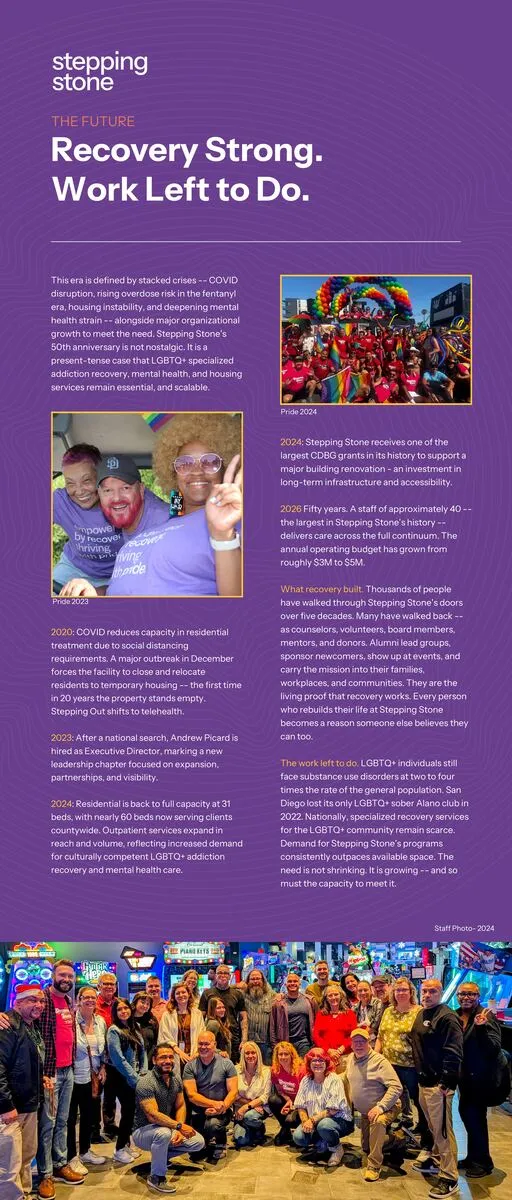
The Future

Recovery strong. Work left to do.

The current era has been defined by stacked crises — COVID disruption, rising overdose risk in the fentanyl era, housing instability, deepening mental health strain — alongside major growth to meet the need. A December 2020 outbreak forced the facility to close and relocate residents, the first time in twenty years the property stood empty. By 2024, residential was back to full capacity at 31 beds, with nearly 60 beds serving clients countywide, and one of the largest CDBG grants in the agency's history funding a major renovation.

Fifty years in, a staff of approximately forty — the largest in Stepping Stone's history — delivers care across the full continuum, with an annual operating budget that has grown from roughly $3M to $5M. Thousands of people have walked through these doors; many have walked back as counselors, volunteers, board members, mentors, and donors.

LGBTQ+ individuals still face substance use disorders at two to four times the rate of the general population, and demand for Stepping Stone's programs consistently outpaces available space. The need is not shrinking. It is growing — and so must the capacity to meet it.

Exhibit panel eight: Recovery Strong. Work Left to Do. — Pride photos and the road ahead
Panel 08 · Lambda Archives x Stepping Stone 50th Anniversary Exhibit

Archival photographs courtesy of Lambda Archives of San Diego. The full traveling exhibit debuted at the 2026 Pink Gala and is available to view online.

Back to About Stepping Stone